Author Feature – Dr. Ashokaditya P. Dhurandhar: Bridging Science and History to Decode the Past
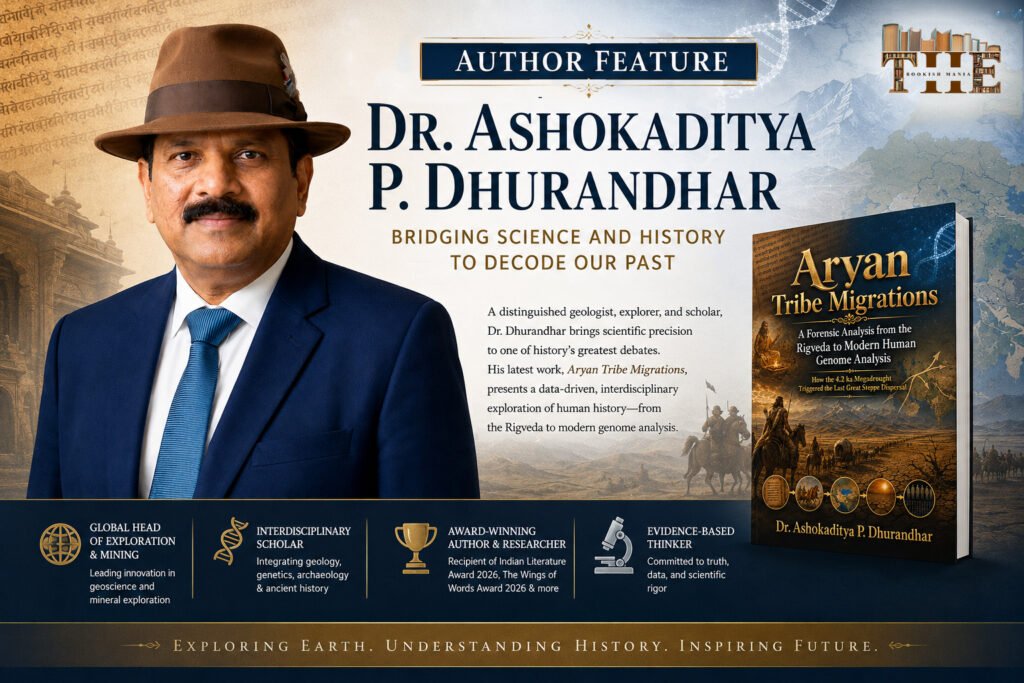
In an era where the boundaries between disciplines are increasingly dissolving, few scholars embody true interdisciplinarity as seamlessly as Dr. Ashokaditya P. Dhurandhar. A distinguished geologist, exploration strategist, and researcher, Dr. Dhurandhar has built a career defined by analytical rigor, scientific precision, and an unwavering commitment to uncovering truth through evidence. His latest work, Aryan Tribe Migrations: A Forensic Analysis from the Rigveda to Modern Human Genome Analysis, stands as a testament to this intellectual pursuit—bringing together diverse fields to address one of the most debated questions in ancient history.
With a strong academic foundation that includes an M.Tech. in Applied Geology, an MBA in Systems and Marketing Management, and a Doctor of Science (D.Sc.) in Geology, Dr. Dhurandhar’s expertise spans both technical depth and strategic insight. As a Professional Geologist and Professional Engineer, he currently serves as the Global Head of Exploration and Mining, leading advanced programs in mineral resource exploration and development. His work integrates cutting-edge technologies, environmental considerations, and AI-enabled workflows—positioning him at the forefront of modern geoscience innovation.
Yet, what sets Dr. Dhurandhar apart is his ability to extend scientific inquiry beyond conventional boundaries. His intellectual curiosity has driven him into the realms of ancient history, archaeology, paleoclimatology, and human migrations. In Aryan Tribe Migrations, he applies the same forensic, evidence-based approach used in geological exploration to historical investigation. The result is a compelling synthesis that draws from paleoclimate data, archaeological findings, textual analysis of the Rigveda, population genetics, and historical linguistics.
The book revisits the long-standing debate over Aryan origins with a fresh, data-driven perspective. By situating Indo-Aryan migrations within the broader environmental disruptions of the 4.2 ka megadrought, Dr. Dhurandhar offers a coherent narrative that aligns climatic events with patterns of human movement. Incorporating recent advances in ancient DNA research—including findings from regions such as the Swat Valley—he carefully evaluates archaeological sites like Sanauli and Rakhigarhi, addressing contentious issues such as the presence of horses, chariots, and Vedic geography.
What distinguishes his work is not just the conclusions it reaches, but the methodology it employs. Rather than relying on ideology or selective interpretation, Dr. Dhurandhar emphasizes the “totality of evidence,” encouraging readers to engage with history through data, critical analysis, and scientific reasoning. At the same time, he acknowledges the limitations of current knowledge and outlines a forward-looking research agenda—highlighting the need for expanded ancient DNA sampling, innovations in paleoproteomics, and advances in computational philology.
Beyond his contributions to geoscience and historical research, Dr. Dhurandhar is also a celebrated author. He has received the Indian Literature Award 2026 and The Wings of Words Award 2026 for his earlier work, The False Veil: How the West Has Painted Shadows upon Africa’s Golden Soul. Additionally, his excellence in scientific research has been recognized with the C-DAC Award (1996) for best research paper and the Best Researcher Award 2019 by the World Research Council for his work in Airborne Geophysics and Remote Sensing.
Dr. Dhurandhar’s writing reflects a rare balance—combining scholarly depth with narrative clarity. His ability to translate complex scientific concepts into accessible insights makes his work valuable not only to academics but also to general readers seeking to understand humanity’s past.
In Aryan Tribe Migrations, he invites readers to move beyond polarized debates and engage with one of the ancient world’s most consequential questions through a lens of evidence, logic, and interdisciplinary synthesis. It is not merely a book—it is an intellectual framework that redefines how we approach history in the age of science.
Through his work, Dr. Ashokaditya P. Dhurandhar exemplifies what modern scholarship can achieve when curiosity meets rigor—offering a powerful reminder that the past is best understood not through assumptions, but through evidence.